I served eight years in the Navy. I was a career counselor — the irony of that is not lost on me — helping sailors find their direction while my own was entirely shaped by the institution I was serving inside of. I deployed to Kuwait and Iraq. For my first couple of years I was the only woman in my unit — and, for a stretch, the youngest person in it. After deployment I was one of only four women who drilled regularly. For eight years, the Navy told me exactly who I was: my rank, my rate, my mission, my tribe. And then I got out.
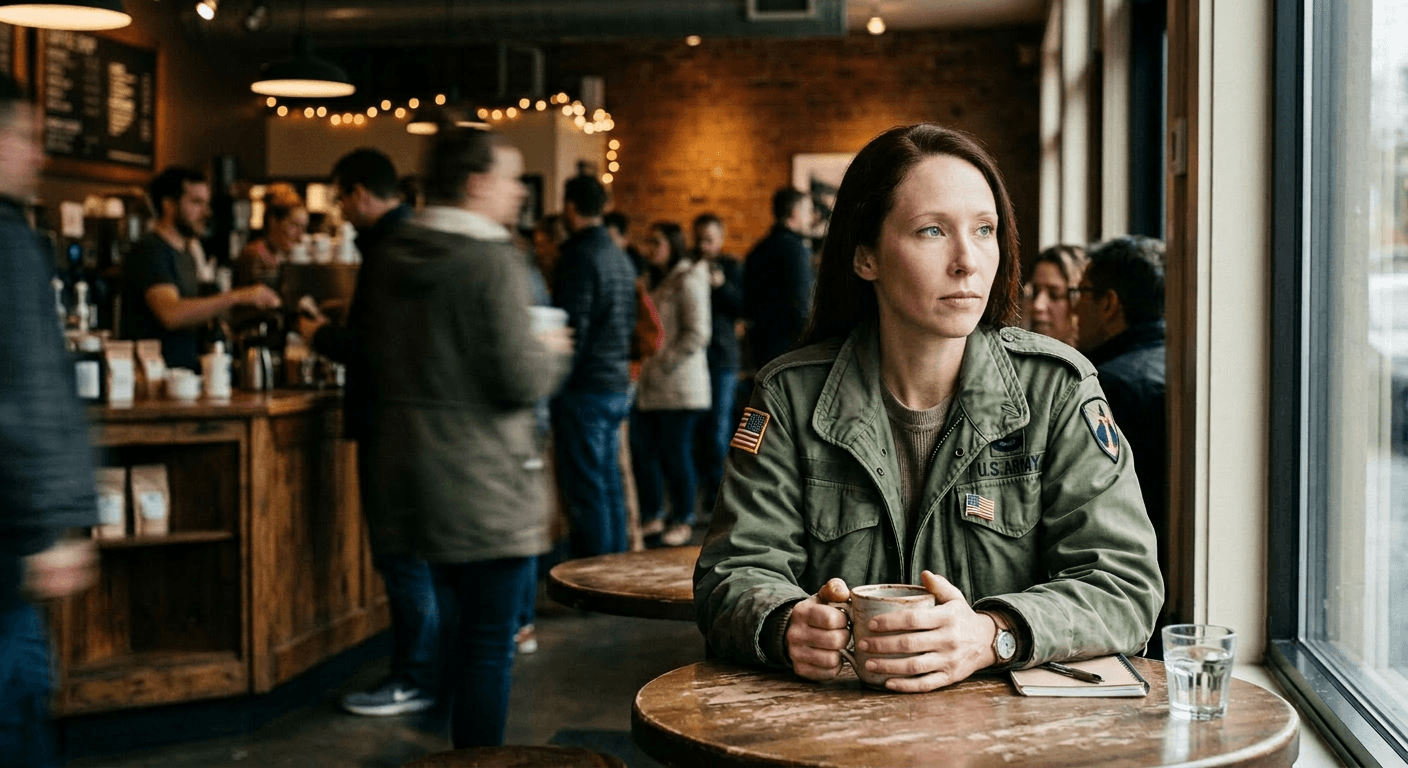
I remember standing in my apartment — not on base, my own apartment — and not knowing what to do with a Tuesday. Not because I had nothing to do. Because for the first time in almost a decade, no one was telling me who to be in it. The silence where my identity used to be was deafening.
The Military Doesn't Just Give You a Job. It Gives You a Self.
From the moment you step into boot camp, the military begins constructing your identity for you. Your name becomes your last name. Your time is not your own. Your purpose is collective, not individual. You earn your place inside a hierarchy that tells you exactly where you stand and what that means. For many of us — especially those who came from instability, or who were searching for belonging — that structure isn't oppressive. It's a lifeline.
What that means, though, is that when you leave, you're not just changing careers. You are losing an entire architecture of selfhood. The rank, the mission, the people who understood you without explanation, the daily rhythm that answered every morning's hardest question — gone. All of it, at once.
The hardest part of leaving isn't the paperwork. It's the silence where your identity used to be.
What Civilian Life Doesn't Have Words For
Civilians aren't lesser. But they operate from a completely different framework of meaning — one built around individual achievement, personal branding, career ladders. If you spent years with your entire sense of self rooted in collective purpose and shared sacrifice, that framework can feel hollow. Or worse, it can feel like a performance you don't know the lines to.
There is grief in this transition. Real, disorienting grief — for the camaraderie, the mission, the version of yourself that existed inside the structure. And most veterans are expected to process that grief silently, quickly, and without burdening anyone with it. Because you're supposed to be grateful to be out. Because civilians don't always have the language for what you lost.
You can be grateful and still be grieving. Those two things are not contradictions. They are the complicated truth of any major ending.
The Work: Building Identity from the Inside Out
The identity the military gave you was largely external — constructed by rank, role, and institution. Rebuilding after service requires something fundamentally different: learning to construct identity from the inside. From your values, not your title. From what you choose, not what you're assigned. This is slower, messier, and no one gives you a timeline for it.
The questions I come back to with the veterans I work with are not "what do you want to do?" They're deeper than that:
- What did you believe in before the military shaped what you believed?
- What values from service are genuinely yours — not the institution's, but yours?
- Who were you becoming before the structure interrupted that process?
- What parts of your service identity do you want to carry forward, and what are you ready to release?
This is identity-level work. It is not self-help. It is not a career pivot. It is the slow, necessary excavation of who you actually are underneath who you were trained to be.
You Don't Have to Have It Figured Out to Start
I didn't have it figured out when I started. I had a degree in exercise physiology, a master's in public health nutrition, years of service, and still no clear answer to the question "who am I now?" I had to find out through the doing — through trying things, releasing things, and slowly learning to trust my own knowing again.
What I know now, having come through the other side: becoming who I am meant to be does not require abandoning who I have been. Your service is part of you. It always will be. The work is learning to carry it differently — not as a definition, but as a foundation.
You are not broken. You are becoming. And you don't have to know what that looks like yet.
Andrea Abella Marie
Lifestyle & Wellness Coach
Andrea helps people build habits that last across sleep, nutrition, movement, and stress, grounded in nervous system regulation. She brings a background in exercise physiology, a Master of Public Health in nutrition, and eight years of Navy service to individualized coaching, virtual or in person, one day at a time.
Continue Reading


Work With Andrea
Ready to turn this into daily habits?
Individualized lifestyle and wellness coaching for sleep, nutrition, movement, and stress, grounded in nervous system regulation. Virtual anywhere, one day at a time.